

by Steven Carlson, Curator
Welcome to another EFFIEgram tracing the art and life of Arizona’s earliest Impressionist desert landscape painter - Effie Anderson Smith (1869-1955).
You are Cordially Invited to Our Current Exhibits in Bisbee & Oro Valley…
Impressions of the Desert with 21 original oil paintings by E.A. Smith depicting familiar vistas around Cochise County and the Grand Canyon - continuing in Bisbee - and hosted by our friends at the Bisbee Mining & Historical Museum. Take a ride up to the cooler altitude of Bisbee and enjoy Effie’s art and a fabulous presentation of Mining History! We are open every day of the week in Bisbee.
The Desert Art of Effie Anderson Smith - Our first ever exhibit of E.A. Smith Fine Art Prints continues at the Oro Valley Public Library through August 29th. See 12 of Effie’s most popular desert landscapes and highlights of her 55 years as a pioneering artist in Arizona. We are open in scenic Oro Valley from Monday to Saturday. Closed on Sunday.
AND NOW - This EFFIEgram brings you another amazing Effie art discovery!
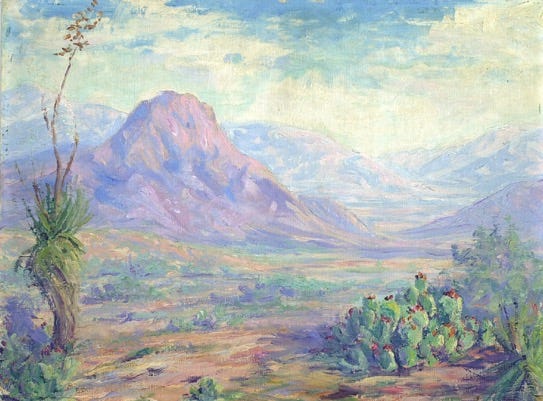
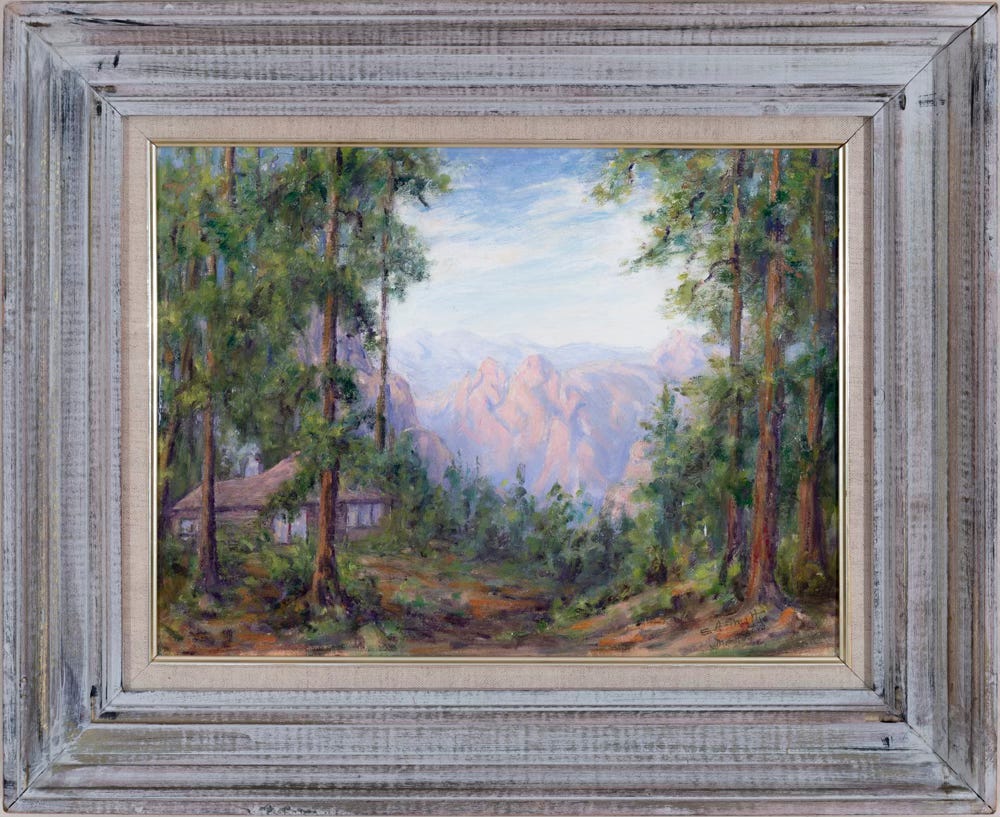
The painting is new to us, but the owner tells of having acquired it from an estate in Tucson about 20 years ago…
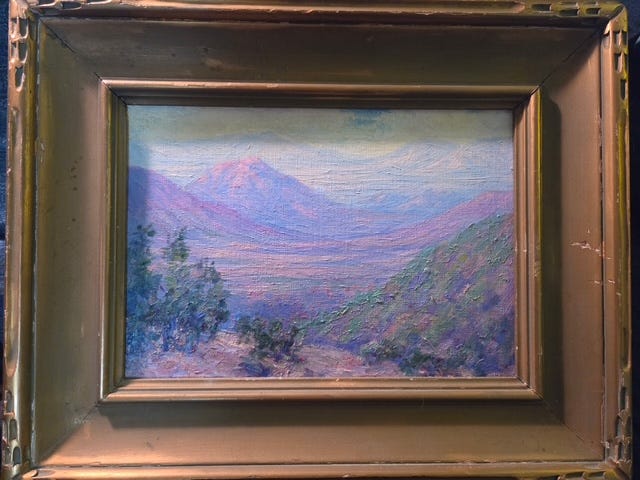
It’s definitely an Effie Anderson Smith work from the 1920s - and unmistakably in her style and color palette for this period. The scene is not known to us. The carved wood frame with bronze metallic paint and Taos-style notched corners match other frames Effie chose for her paintings in the 1920s. We know Effie was painting in the Northern New Mexico countryside around Cimarron (“where the rockies meet the plains”) - not far from Taos - for a good part of 1924, so it’s possible she encountered and admired that style of frame. Could this be one of Effie’s New Mexico paintings?
The frame is actually one Effie would have acquired from her framer of choice at this time - the Kanst Gallery in Los Angeles - who was probably the most influential art gallery of the time in L.A. and handled most sales of Effie’s paintings in Southern California from the late 19-teens and throughout the 1920s in downtown L.A. and later at their gallery and residential showroom on Mulholland Drive. Kanst was also a supplier of high quality custom made carved wood picture frames to many of the leading Southern California Impressionist artists.
The photo of this painting was provided to us a couple weeks back by a private collector who commented she owned one of Effie’s pantings while reacting to one of our Facebook posts highlighting our current Effie exhibits in Oro Valley and Bisbee. We look forward to visiting with the collector on a future Arizona visit to document this and another painting they know of, for the catalogue raisonne we are developing on all the known and authenticated paintings by Effie.
Thanks to our new collector friend Mickey for making this photo available!
Effie’s July Milestones … Key summer memories and moments across her lifetime…
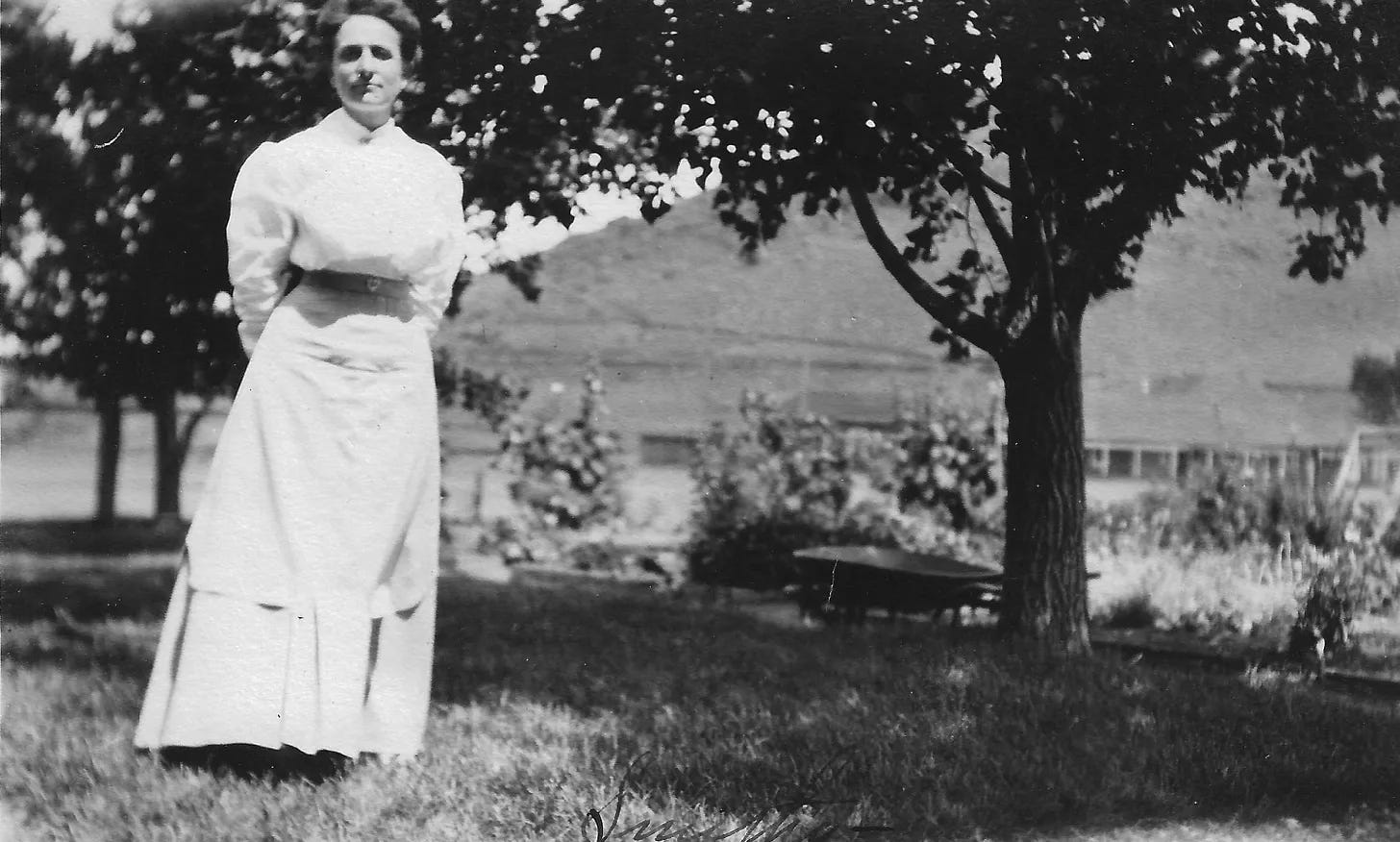
For many of us, summer brings a change of routine. It can even be downright disruptive, pushing you out of your normal patterns, bringing with it a season of travel, celebrations, picnics, gatherings and holidays. A century or more ago, if you were in the countryside, it may mean certain seasonal chores on the farm or ranch. If your life was mostly in town, you may have had a summer escape to the country if time allowed. Depending on the region of the country you lived in, the summer weather dictated where you chose to go and what you planned to do in your summer travels and activities. Through most of Effie’s life, summer included painting.
As I’ve traced and reconstructed Effie’s life over more than a decade of research, from her birth and formative years in Arkansas (1869-1893), her brief chapter as a school teacher in New Mexico (1894-95), as a pioneer settler in Arizona (beginning in 1895), and through the period of renewing and refreshing her artistic technique in oils as a landscape painter with the California Impressionists (1914-1929) - several themes have emerged. One of these shows us that many of the key moments, experiences, decisions and milestones of her life occurred during the summer months - most especially in July.
These July milestones appear to have had a major role in shaping her outlook, world view, and character - propelling her toward achieving her dreams of a full and rich family life as wife and mother - while she also strived to preserve her personal independence as a school teacher, artist and civic activist.
There were many such important summer moments - and as I’ve said - especially July moments that influenced her life - specifically her artistic and civic life.
Here are a few…
July 4, 1876 - Our Nation’s Centennial…
Nearing her seventh birthday, Effie would have experienced our country’s 100th Independence Day and retained some memory of it. How much of a memory - we cannot say for certain. As the Civil War had ended only 12 years before the Centennial, the degree of July 4th celebrations while Effie was growing up in Hope, Arkansas was likely somewhat muted, as was the case during Reconstruction across much of the South. There had been little progress in Arkansas recovering from the economic and social turmoil during that period. The financial panic of 1873 was also a factor as well as the lack of a banking system, with local merchants mainly in charge of who got credit. Most local people were still struggling a decade after the war’s end.
At the time of the 1876 Centennial, Effie’s father was an alderman in Hope, and both her parents were socially and civically active in business, church and masonic activities, so it’s likely if there was much of a July 4th celebration in Hope that year, Effie would have known about it. Hope was only incorporated as a city the year before the Centennial in 1875, so it’s likely there were many factors at play.
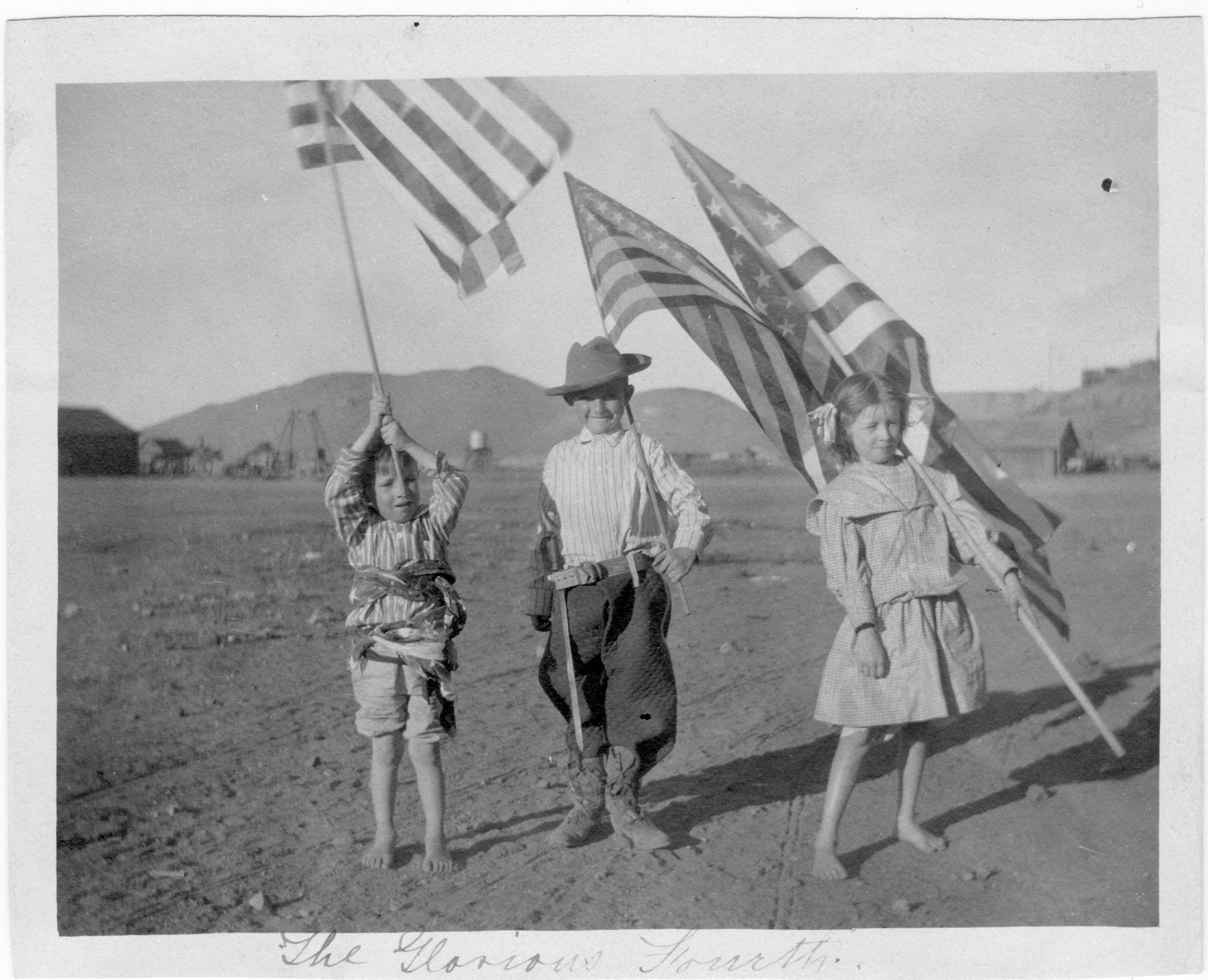
By the time Effie was married and living in the mining camp at Pearce, Arizona Territory in the early 1900s, we know she was enthusiastically celebrating the holiday with her family and friends, and referring to it as “The Glorious Fourth”. Effie’s lifespan would also include celebrations of our nation’s Sesquicentennial on July 4, 1926.
July 1884 - An Artist’s Journey begins…
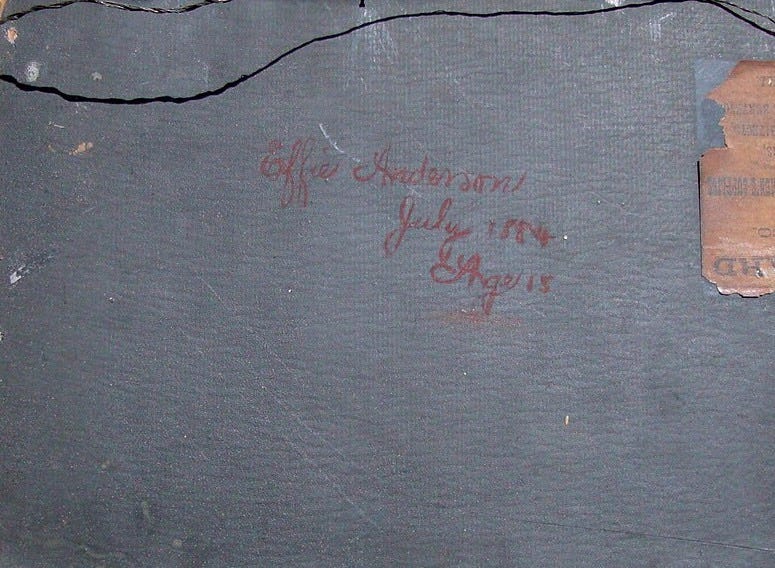
At age 14, Effie is painting in oils and already has a sense of composition, is defining a color palette she would mostly adhere to the rest of her artistic life - with violet, the base color of the French Impressionists. We need to remember that Impressionism as a style of painting was - at the time Effie painted this scene in 1884 - very controversial, and considered an emerging form of contemporary art, still not accepted by most art critics or academies.
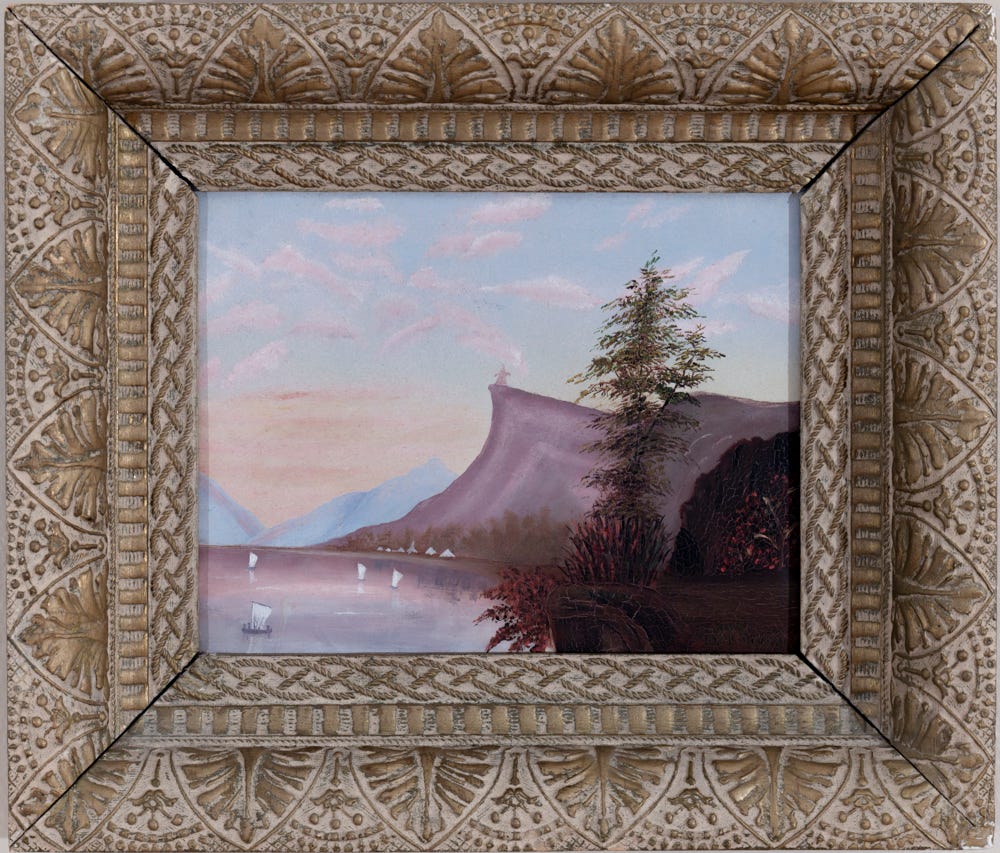
Effie’s emotional response to a landscape here - whether real or imagined - her fascination with dramatic mountain scenes of a kind she would later specialize in after her arrival in the West, are already evident, among some other elements she has infused from more traditional Hudson River School style painting - particularly noticeable in the feathery tree and shrubs.
It’s clear that Effie’s painting in July was the result of talent and passion, not something for school this time of year. And not something just dashed off like a sketch or drawing. She devoted significant care and time to the composition and execution here, as well as to the choice of a frame. A rosy sunset and distant mountains are present in an early form here which she would paint more masterly in years to come.
The figure on the escarpment cannot easily by explained. But when you are 14 or 15 years old and have accomplished something like this, why not project yourself -somewhere into the scene?
July-August, 1892 - Effie’s Grand Tour of the Upper South, the Northeast, and More
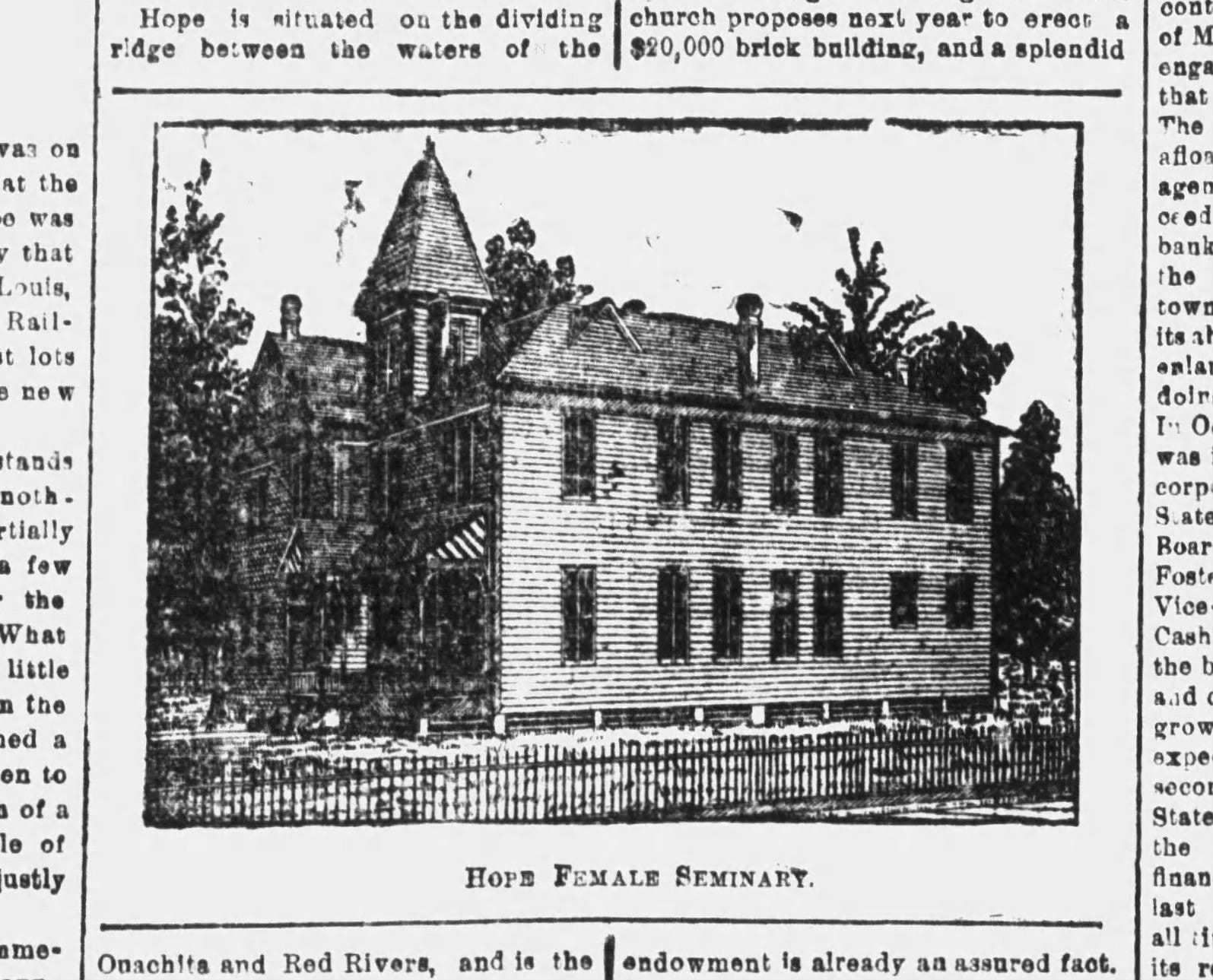
One of the few career options deemed appropriate for a young Southern Lady outside thw family home in the late 19th Century (especially if she was unmarried) was the role of a School Teacher. Effie’s parents were both very well educated for their time, with her mother having attended a Female Seminary for Woman in nearby Washington, Arkansas and her father having attended the University of Virginia in 1852 and 1853. His academic records indicate his studies prepared him for work as a civil engineer. So Effie attending and graduating from Hope Female Institute to gain training as a teacher was very likely supported by her family.
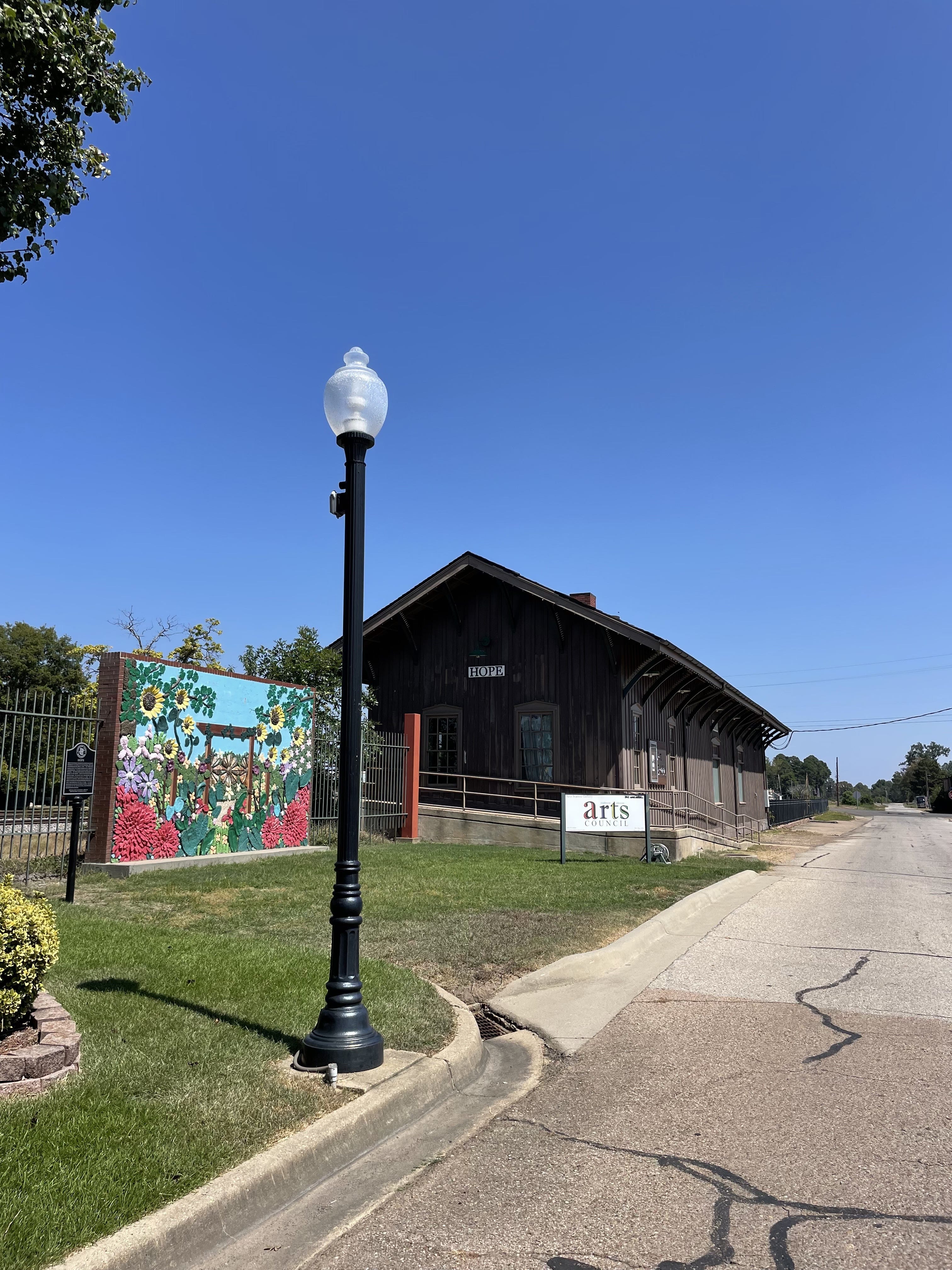
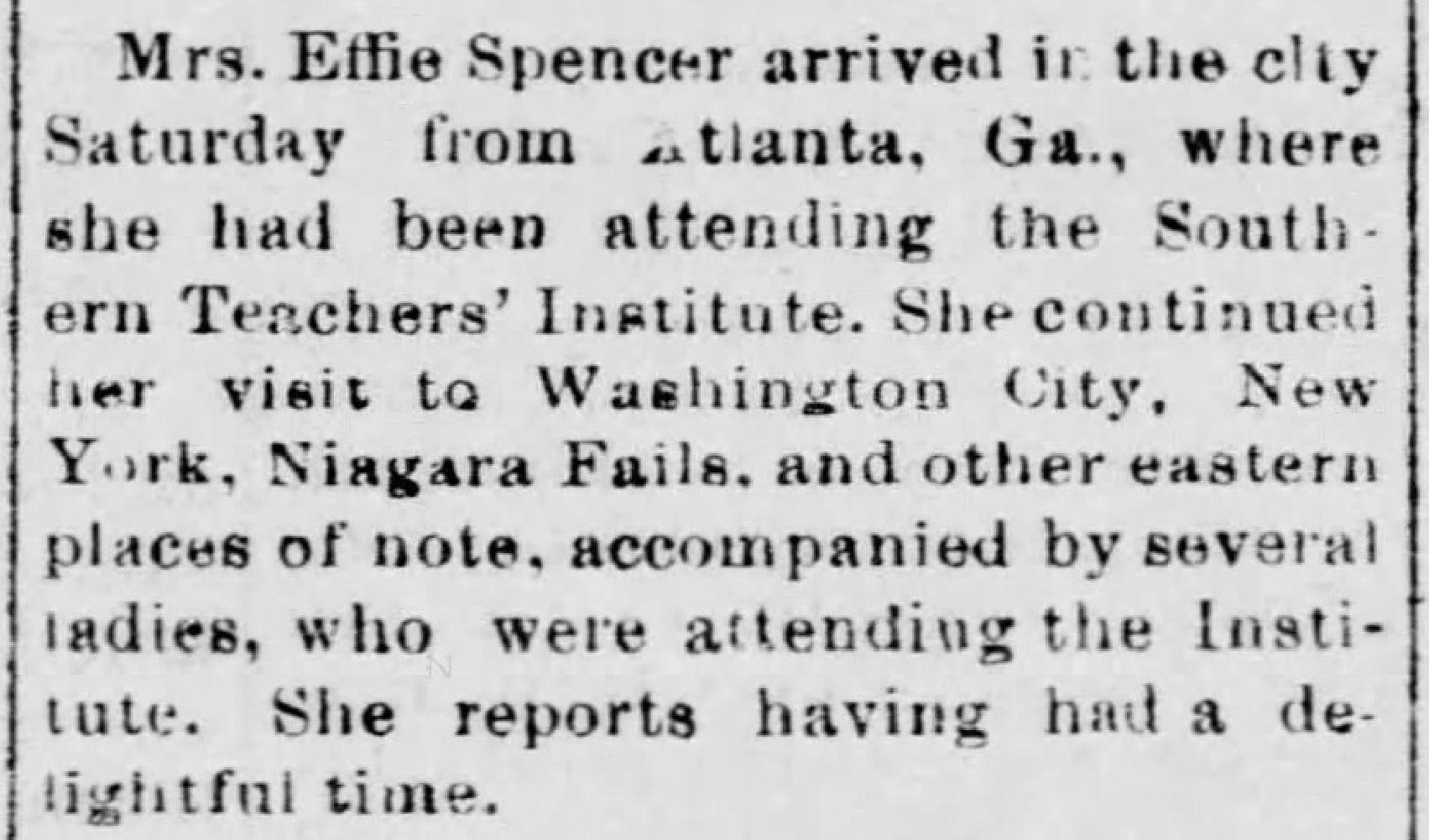
On July 5, 1892 the Nashville, Arkansas newspaper announced that Mrs. Effie Spencer (her married name at this time) had been appointed Assistant Principal for the 1892-93 school year. But Effie was not in Nashville. She had left a few days earlier from Hope Station by train to participate in the very first Southern Teacher’s Convention in Atlanta (July 6 to 9). It was there she banded together with 3 other young women for a train trip up the Eastern seaboard to Washington City (D.C.), with a side trip to Mount Vernon, then on to Philadelphia, and New York where coincidentally the first generally accepted exhibits of Impressionist paintings were finally being embraced by American art lovers and critics.
From New York City, Effie traveled on to one of the most popular natural wonders of the time with the end of her Grand Tour providing a visit to breathtaking Niagara Falls. The itinerary meant Effie was away from her home towns in Southwest Arkansas from early July through late August 1892. For a 22 year old widow, who had been through the loss of her beloved Willie followed by more than a year of mourning, healing and coming to terms with shattered dreams of the married and family life she had envisioned for herself, this travel must have given her a new sense of herself - away from home and family so long, with a new group of friends. It must have been a real eye opener and a dose of fresh life experiences.
This was the beginning of Effie’s love of train travel, and she would return by train in later life to Washington, Philadelphia and New York for her 1931 exhibits. She would also travel by train to vacation spots such as Atlantic City in the East, Redondo Beach and Long Beach on the West coast, and as far south as Mazatlan.
One imagines Effie may have been moved and inspired to at least sketch some of these sites and vistas she saw on her many travels, to develop as future paintings, but if she did so none have survived. She seems to have loved spending time near the ocean, but only her Arizona desert home truly inspired and fueled her art.
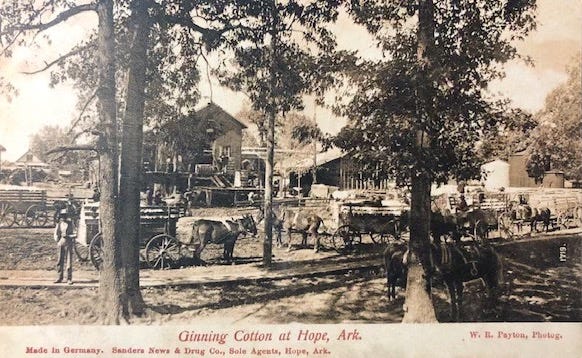
July 28, 1893 - Farewell to Arkansas. Arkadelphia’s Southern Standard newspaper reported Effie’s elder brother George is accompanying their mother Adelia to say farewell to friends (including Effie’s late husband’s family) as the Anderson women (Effie, her mother and younger sister Carrie) prepare to leave Arkansas with their brother for a new home and life in the New Mexico Territory. Effie’s father - Major Adolphus Anderson - had passed away about 4 months prior. Effie’s mother Adelia is also believed to be in ill health at this time, possibly with tuberculosis - and it was thought the dry climate of Deming would be more beneficial. One of Effie’s uncles was engaged in building a camp for tuberculosis patients in Deming, and had just recently completed enlarging his home. He and his family stood ready to greet the Andersons on arrival.
Add to all that the economic uncertainty following the financial panic of 1893 which began in February, and a devastating tornado that ripped through Hope and vicinity in June 1893. Plus, the news of Adelia’s first grandchild was on the way in the fall, to be born in New Mexico. Suffice it to say - there were plenty of factors - negative and positive - in the lives of the Anderson women at this time to compel them to consider relocating.
So, decisions made - Effie and younger sister Carrie would accompany their mother and brother to Deming in late summer 1893 - and both Effie and Carrie would seek teaching positions there, which they both achieved for the 1893-94 school year.
July 1895 - From New Mexico to Arizona - Effie’s Second Chance at Happiness
In some cases these July milestones in Effie’s life involved decisions that proved to be major inflection points, clearly changing the course of Effie’s life. In that category would be her decision in early 1895 to accept Andrew Young Smith’s proposal in Deming - to join him by summer in Bisbee, Arizona Territory to become his bride on August 1st at the Bessemer Hotel.
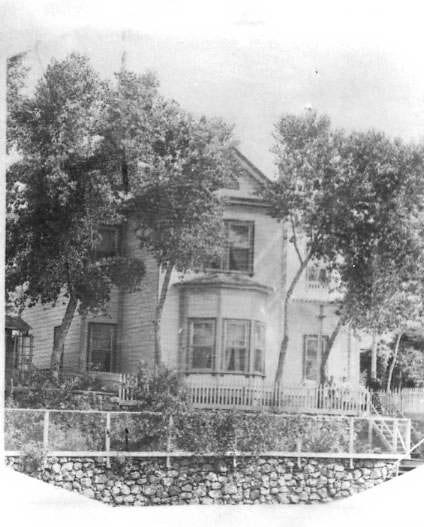
By early June newspapers report that A.Y. Smith is visiting in Benson. No doubt he was there to arrange a transfer from his railroad depot job in Deming down the line to Benson, where he and Effie would make their first home in Arizona and he could keep an eye out for a job with more upward mobility (as we would say today) in the mining industry. Given he had trained in his teens as a stone cutter in Missouri (after immigrating from Scotland) those skills along with his understanding of the railroad networks and his clerical skills positioned him well to pivot into mine management.
As a 26 year old widow who lost her first husband in Arkansas to tuberculosis after only three months of marriage, 1895 presented Effie with a second chance for the kind of family life she had hoped she was beginning six years before, but lost so quickly, when her first husband Willie died unexpectedly. A new life in Arizona with the charming A.Y. Smith offered a much brighter future than remaining a widowed school teacher in Deming.
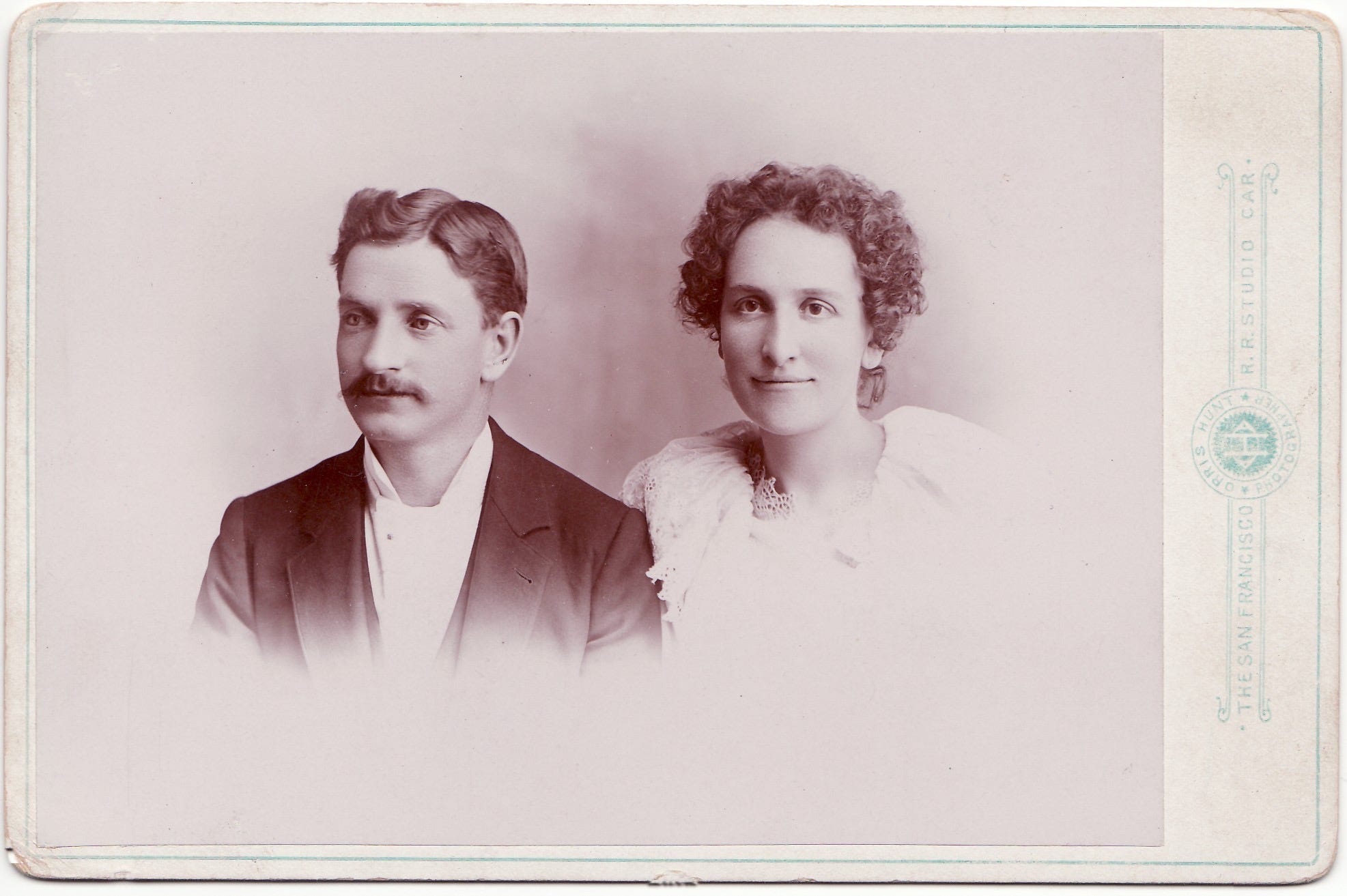
So the month of July 1895 was filled with the joyous and frenetic activities of preparing for her second wedding, a new life with Andrew in Arizona, and in the last days of July - making the journey from Deming to Bisbee where Effie knew nobody, but Andrew (A.Y.) was already known and had local ladies at the Bessemer Hotel preparing everything for the bride to be, including a ceremony and reception in style.
Effie was once again realizing one of her major life goals of marriage and family being central to her identity.
July 1896 - From Benson to Pearce…
After a year in Benson where Effie and Andrew established themselves in the bustling railroad town, with Effie substitute teaching when called upon and A.Y. getting some local experience at Benson station, Andrew would soon ask for letters of reference from his railroad employers with an eye to landing a job as bookkeeper at the Commonwealth Mine in Pearce. In June, A.Y. is quoted as saying he had accepted the position, and would be moving his wife and newborn son (Andrew Bosworth Smith, born May 5th) to Pearce in July. It was the beginning of Effie’s 50 years of residency in Pearce in what she would soon refer to as her desert paradise.
July 1910 - Revolution and its ripple effects…
A period of Mexican elections which concluded July 10, 1910 sparked a rebellion that turned into a decade long Revolution, with many battles and sieges taking place just across the border from Douglas and Bisbee for the next 10 years. The impact of this for Effie & A.Y. Smith was this. By the following year, after U.S. troops stationed in Douglas were attacked by Mexican federal forces during the First Battle of Agua Prieta and reports of bullets flying thick into Douglas at times, the Smiths don’t feel comfortable placing their son into one of the borderlands high schools in nearby communities when he is ready in 1912. Additionally, they were thinking more along the lines of a military school for Lewis.
The Smiths also likely felt the need to be in one of the larger cities on the California coast where major investors could be met so that A.Y. - in his role as President and Superintendent of the Commonwealth Mine - had prospects of securing funding for the rebuilding of the mine’s mill, which had recently been consumed by a catastrophic fire on March 23rd, 1910. By June of 1911, the Commonwealth had new investors and ownership, but A.Y. and Effie were not yet done in Pearce. For a time they would be away from their Arizona home, but Pearce was never far from their hearts.
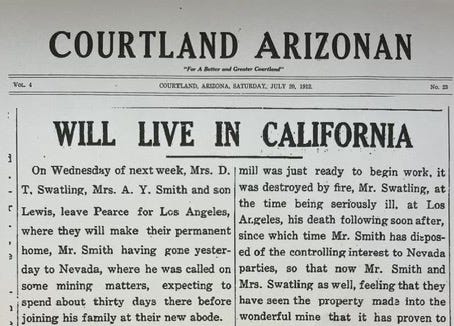
July 26, 1912 - So announced the headline in the Courtland Arizonan - the local newspaper in the neighboring central Cochise County copper and turquoise mining camp, referring to the Smith’s decision to leave (at least, temporarily) their beloved home in the mining camp in Pearce. Mrs. Emma Swatling (following the death of her husband David) now is the primary investor in the Commonwealth Mine, which A.Y. Smith manages. Emma invites Effie and A.Y. to bring their son to her Los Angeles home and take advantage of the educational opportunities available at nearby schools.
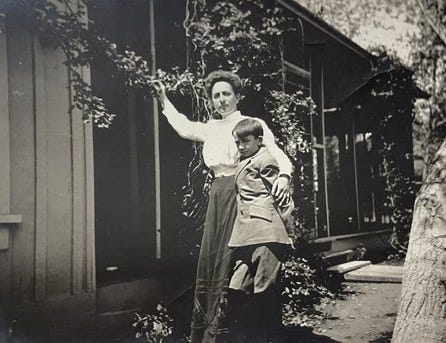
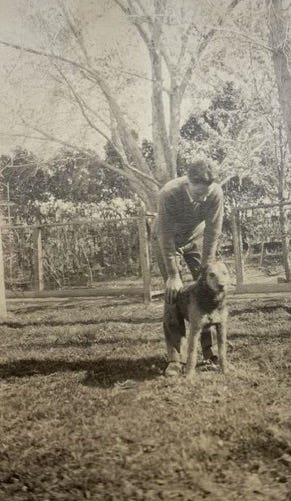
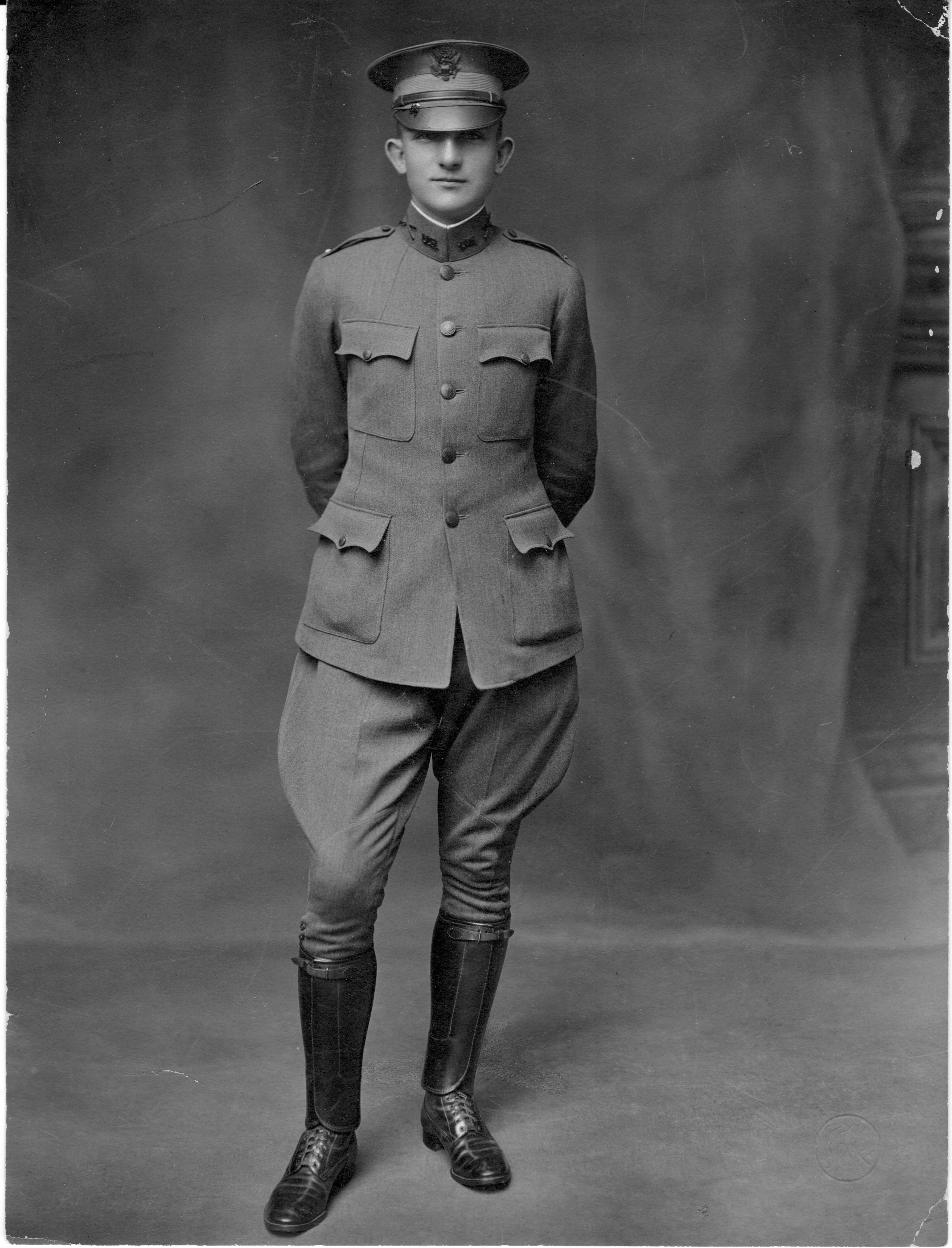
During their years in Los Angeles, the Smiths took up residence in the affluent neighborhood known as St. James Park. Their time in L.A. allowed young Lewis Anderson Smith to attend high school, and A.Y. to go about seeking mine investors. He did this through his growing friendships with men he met through participating in athletic clubs and lodge activities. It was a new network of investor prospects populated with seasoned mine investors. For Effie, her L.A. networking soon brings her into contact with the artists of the Los Angeles, Pasadena and Laguna Beach art colonies where her painting technique will undergo a transformation.
Interestingly, none of Effie’s art depicting California vistas has survived. Paintings and sketches she created there during her studies with Anna Hills in Laguna Beach or at the Stickney Memorial Art Institute in Pasadena with her most influential mentor, Jean (Gene) Mannhiem, were probably considered by her to be ‘off topic’. She may have kept some. A few studies perhaps, but once she fell in love with her Arizona desert and mountains, little else seemed to inspire her creatively.
June 1914 - Although the Smiths are spending much of their time in California, the Tombstone Epitaph reports on June 14th the Smiths had moved into their ‘new’ home in Pearce. With son Lewis established in school in L.A. and soon to go on to more in the San Francisco Bay Area, the Smiths are more frequently returning to Pearce as the 19-teens progress, and were back fully in Pearce by the time Congress votes in April 1917 to declare war on Germany.
1926: The year Effie infused her art with something new …
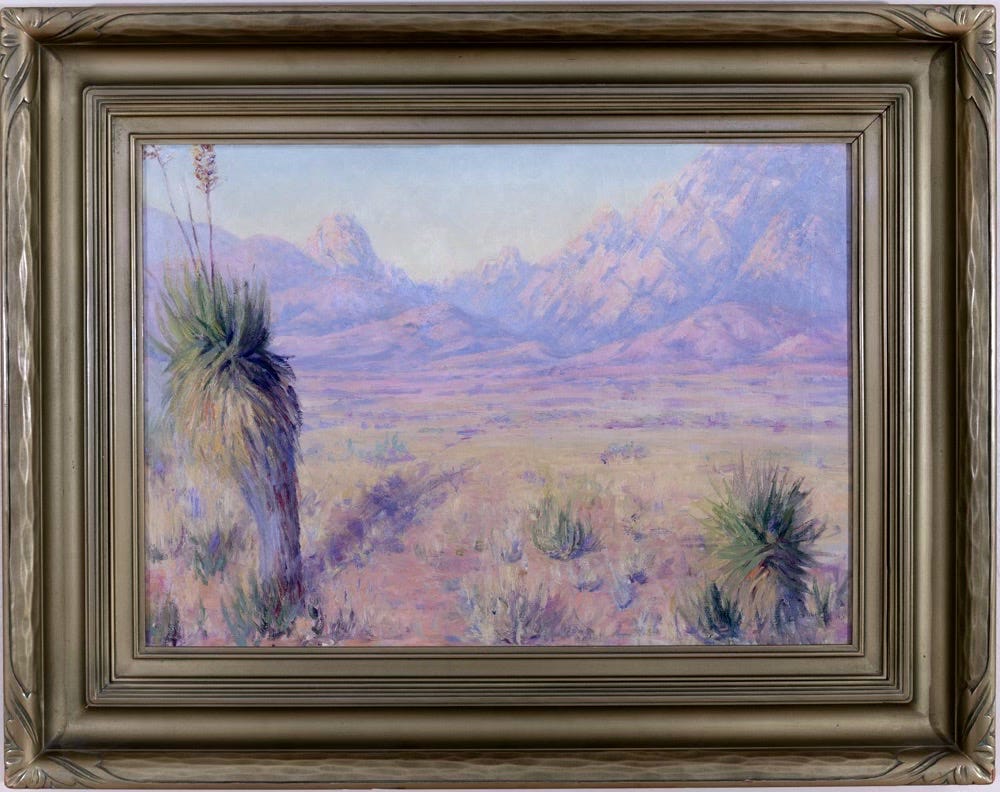
We don’t know just how this happened. Or what happened, or who she may have met or been studying with who helped Effie elevate her technique, resulting in a more subtle and nuanced effect of shadowing and an etherial quality not seen in most of her earlier art. Or - she may have struck on something working on her own after so many years of painting and sketching and admiring the art of her teachers in California.
Beginning with her paintings in 1926 there is something much more refined that she is achieving in the variations of light on the facade of Cochise Stronghold. Even in the gradation of colors from the grasses in the foreground into the midrange, Effie is infusing her paintings with more depth and emotion than ever before.
The year 1926 was also the 30th anniversary of Effie’s arrival in Pearce. And we know that Effie had already painted this vista of Cochise Stronghold in the nearby Dragoon Mountains more than a dozen times - and certainly more than any other scene around her. She would paint it dozens more times during the next 20 years that she would be within sight of it and under its spell as a resident of her desert paradise in Pearce.
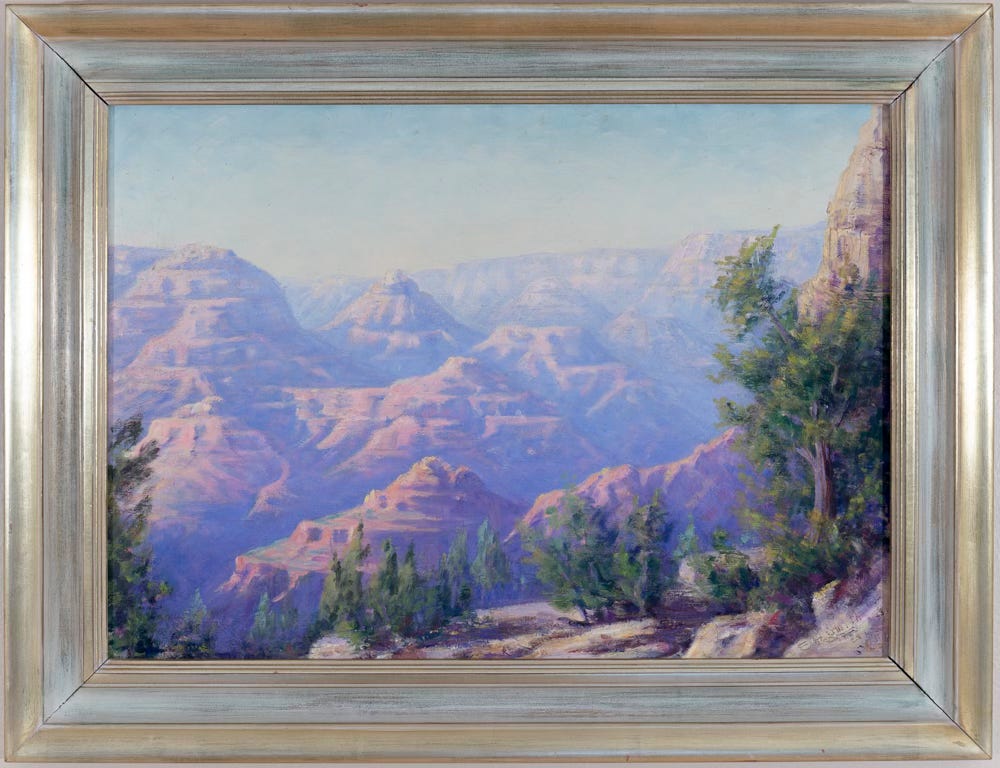
1926 was also the year Effie traveled extensively in Northern Arizona, painting at the Grand Canyon, at Flagstaff’s San Francisco Peaks, and dining at Shekayah Ranch and Trading Post at Tuba City, as reported by the Coconino Sun on July 23rd, 1926. The newspaper lauded Effie as “an artist noted throughout the state as it’s great exponent of the beauty of the southern desert and cactus growths” and reported Effie was “enthusiastic over the charm of the Painted Desert.” The colors she saw there seem to have affected her deeply.
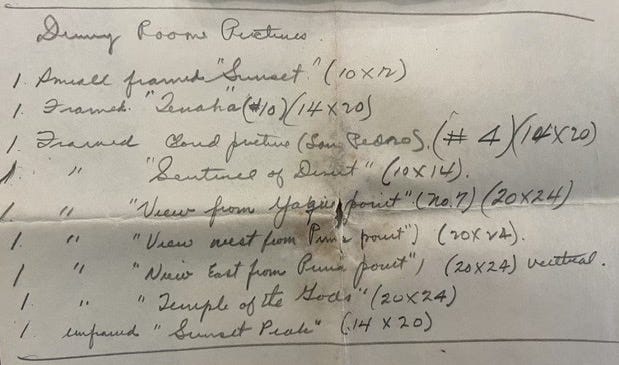
We know Effie loved her paintings that resulted from that 1926 Northern Arizona trip because she had hung many of her favorites in the dining room of her home in Pearce - so as to enjoy them herself and perhaps even to show them off to dinner guests and the constant stream of mining related visitors to the Smith’s home who met with A.Y. Smith around the dining table as their residence also served as the Mine Manager’s House.
Sadly, we have no way of comparing the Cochise Stronghold painting (above) with the Northern Arizona paintings she completed around this same time (listed below) because so many of these perished in the fire that consumed Effie’s house and studio on September 17th, 1929. We can only see the 55 titles and descriptions of her paintings in this inventory, written in her son Lewis’s hand.
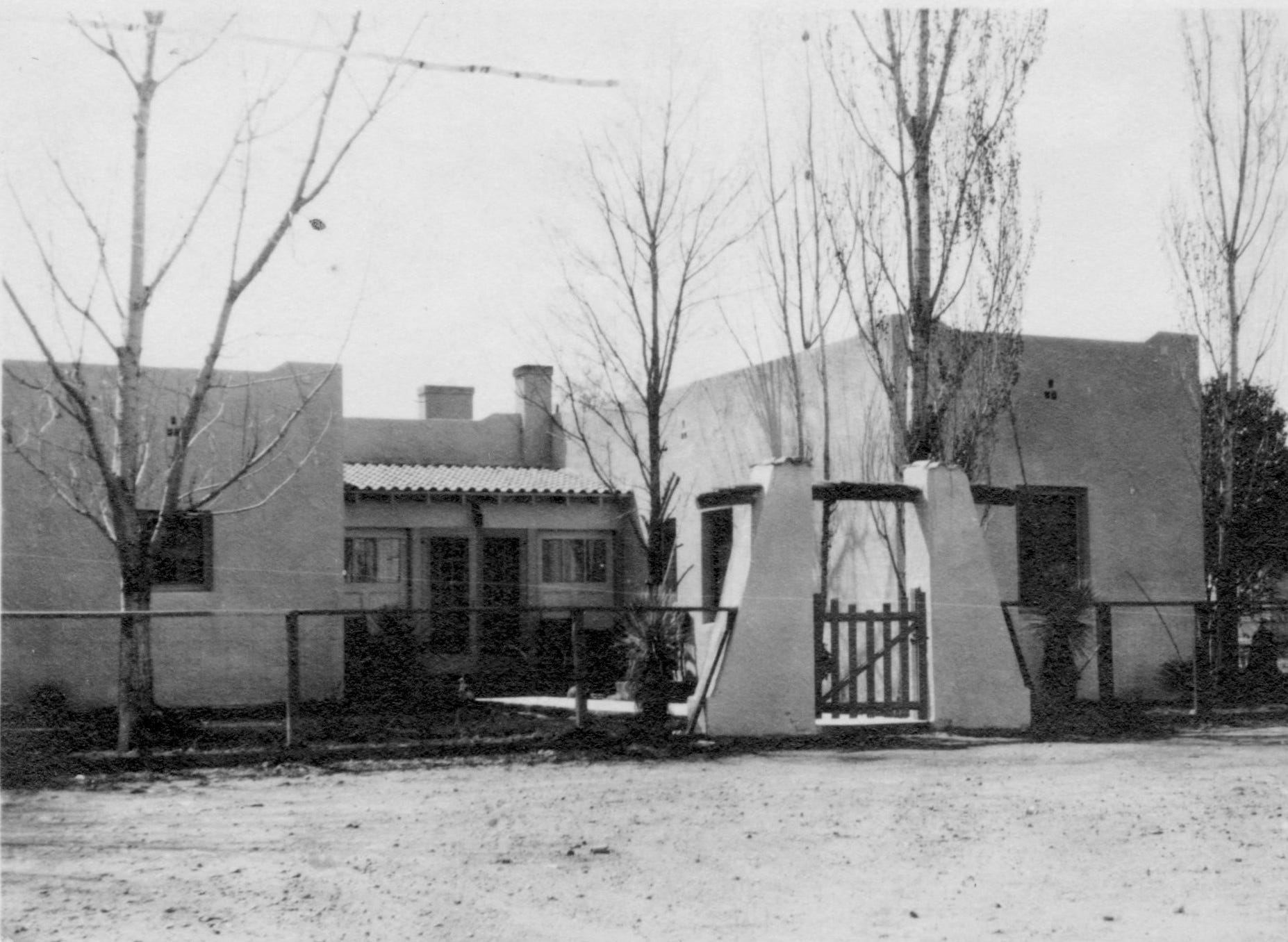
In a July 30, 1930 letter Effie wrote to her dear friend, future congresswoman Isabella Greenway in Ajo, Effie referred to this great loss…
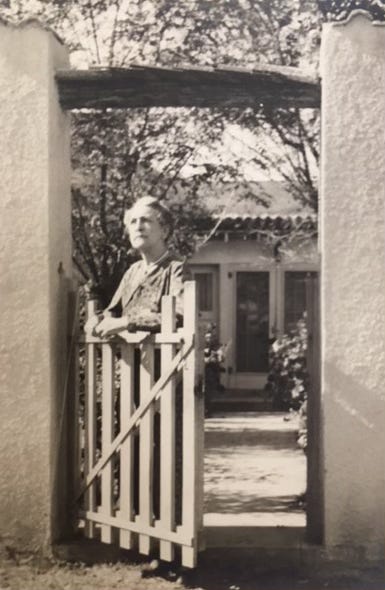
I wish you’d come to see us - we are so comfortable in our new house – and have a guest room ready for you at any time.
I miss the old house so much and many of our most cherished possessions were burned with it. But then Mr. Smith’s miracle recovery from his desperate illness has compensated for everything. He is so very well again….
- from the Isabella Greenway Papers at Arizona Historical Society, Tucson.
July 22, 1931 - The Arizona Daily Star mentions the return of Effie & husband AY Smith from Effie’s Eastern exhibits in Washington, Philadelphia and New York, with a stop in Pittsburg on the return. The fire that destroyed Effie’s home with 45 years of paintings inside - many she had recently created for her forthcoming 1931 Eastern shows - did not stop her from recreating the lost works and taking 20 new paintings with her for these exhibits just 18 months after the fire.
Also by now, the ripple effects of the 1929 stock market crash that occurred just days after Effie’s home burned to the ground, and what would be known as the Great Depression that followed, were seriously disrupting almost every aspect of life in America - but not Effie’s determination to get to her shows in the East. Despite economic conditions, she sold many of the paintings she took with her for those exhibits, and came back with commissions for more paintings from her well-off eastern admirers.
Throughout the 1930s & 40s - Summer Paintings in the Mountains…
Not long after the Smiths returned from Effie’s successful exhibit tour in the East, husband AY Smith’s health took a rapid turn for the worst, and he passed away in October 1931. After spending time over the coming months with friends and family, especially at Thanksgiving and Christmas, Effie threw herself into her work - instead of teaching (which she embraced after the death of her first husband Willie in Arkansas) it was painting. Her art was her refuge, as it had been after each of her children’s death in infancy, years before, and now after her beloved husband Andrew’s passing. Friend Isabella Greenway agreed that Effie would have a show at her new Tucson hotel and resort - the Arizona Inn - beginning in January 1932 and Effie presented one of her most compelling talks, entitled The Relation of Sound to Color to her friends and admirers at the Tucson Woman’s Club in March 1932.
As the summer of 1932 approached a high school student from Bisbee asked her parents if she could stay with Effie for a month to learn Effie’s daily painting practice and study Effie’s style and technique. Eleanor Troy Boss (later Eleanor Cate) already had a passion for art and a vision of herself as an artist - and fully embraced all Effie taught her (see image below). Eleanor (then age 15 - about the same age Effie was when she painted her early 1884 landscape - see above) would later go on to study art and education at the University of Arizona and pursue a teaching career in art that would take her to the Philippines and Hawaii - as her husband was stationed there during his military service.
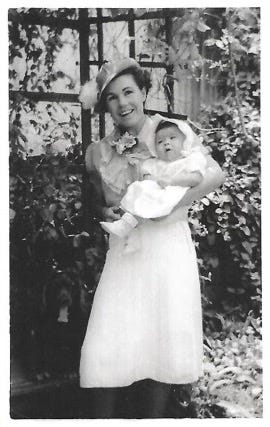
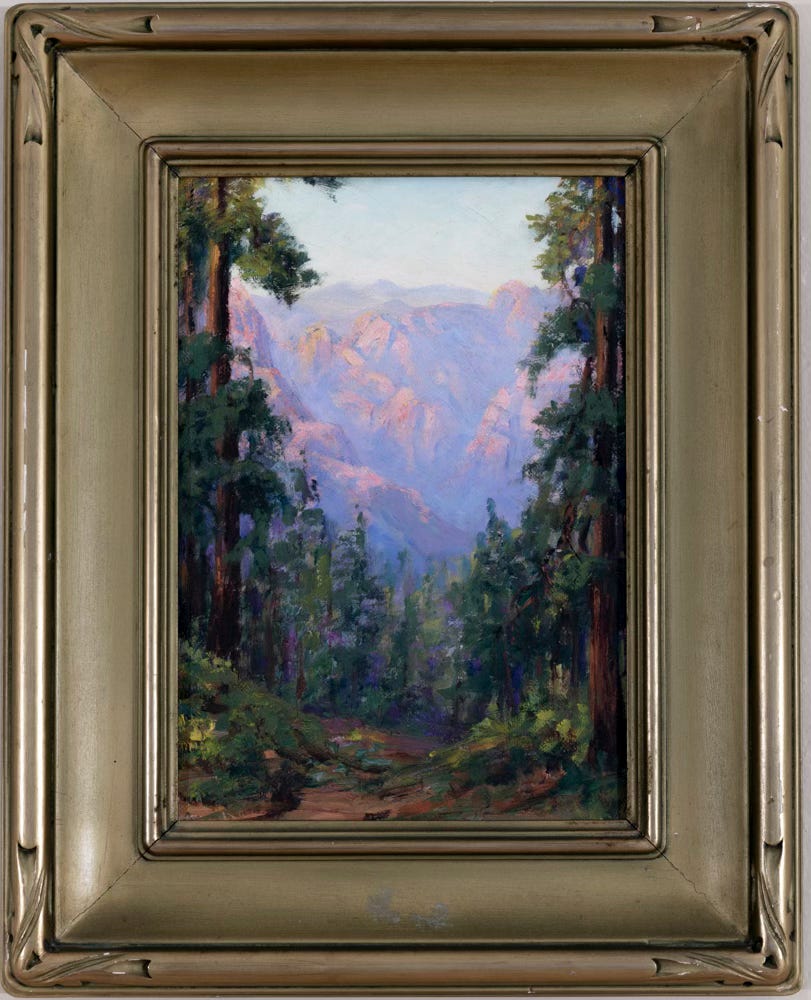
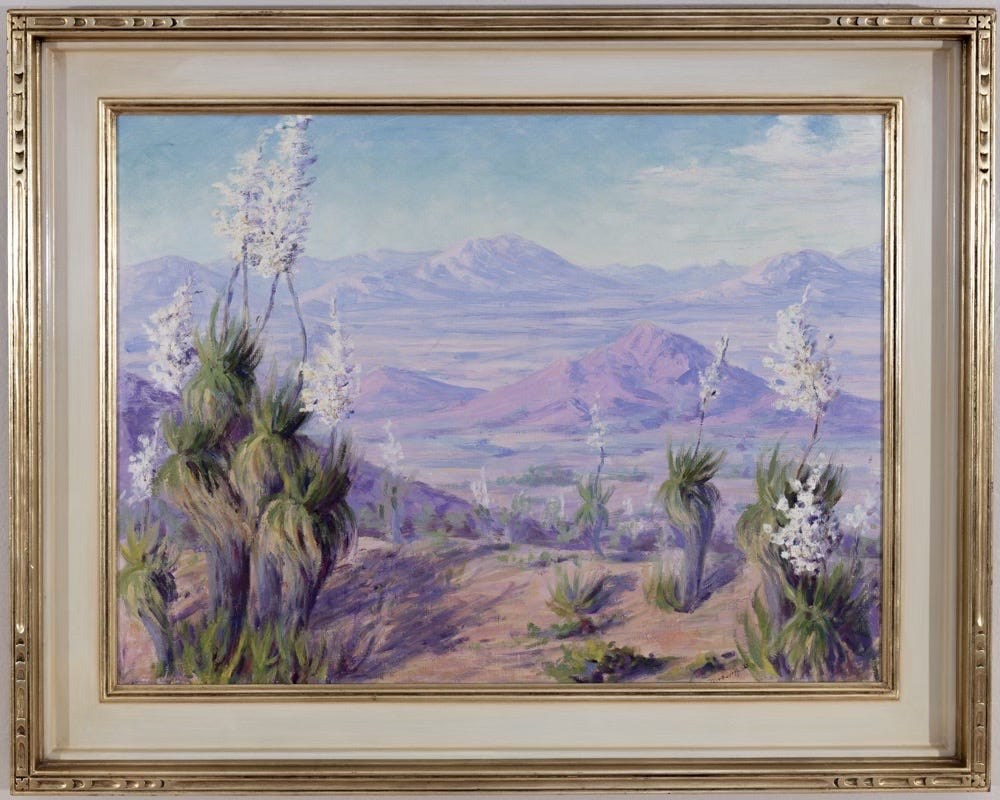
As the 1930s went on, Effie still managed to break away during the summer heat to visit friends in high places (literally - at the 8,000 feet level at Rustler Park) to paint high in the Chiricahua Mountains overlooking Cave Creek Canyon. It didn’t happen every year but we know of at least two paintings that Effie appears to have painted there - possibly on commission from her friend Iris Rice of Douglas and later Colorado. It’s usually a commission when Effie includes a building or some other trace of human life or activity. These wonderful paintings date from 1932 and 1943. There are likely other paintings she created in the Chiricahuas in the hands of people who knew her that are still unknown to us, along with those she painted in Portal depicting the Entrance to Cave Creek Canyon from the East. Let’s all keep an eye out for them!
World War II and the 1940s - Effie in her 70s…
Despite not traveling much during the War, Effie is still able to connect with her art students in Douglas and make a seasonal life there. I say seasonal because part of the year she traveled to Clifton and Morenci to stay with her son Lewis and daughter-in-law Norma and paint there, beginning a new series of scenes along the Coronado Trail in those years.
In the mid-1940s the Giles family comes forward to acquire Effie’s home in Pearce, which she still owns but has visited less and less. By now she is age 77 and living much of the year at the Hotel Gadsden in Douglas. There she has found a community who appreciates her and her art. Most of her Douglas friends and students consider Effie to be as much from there as anywhere else, given Effie, her late husband and son were longtime members of St. Stephen’s Episcopal Church and had been coming to Douglas weekly for social and civic activities for decades. Nevertheless, selling her Pearce home and leaving her desert paradise of nearly 50 years brings with it the bittersweet realization of the end of a major chapter of her life - and of her creative life. Now Douglas and vicinity, the Swisshelms and Mule Mountains becomes the prime focal points of her artistic life.
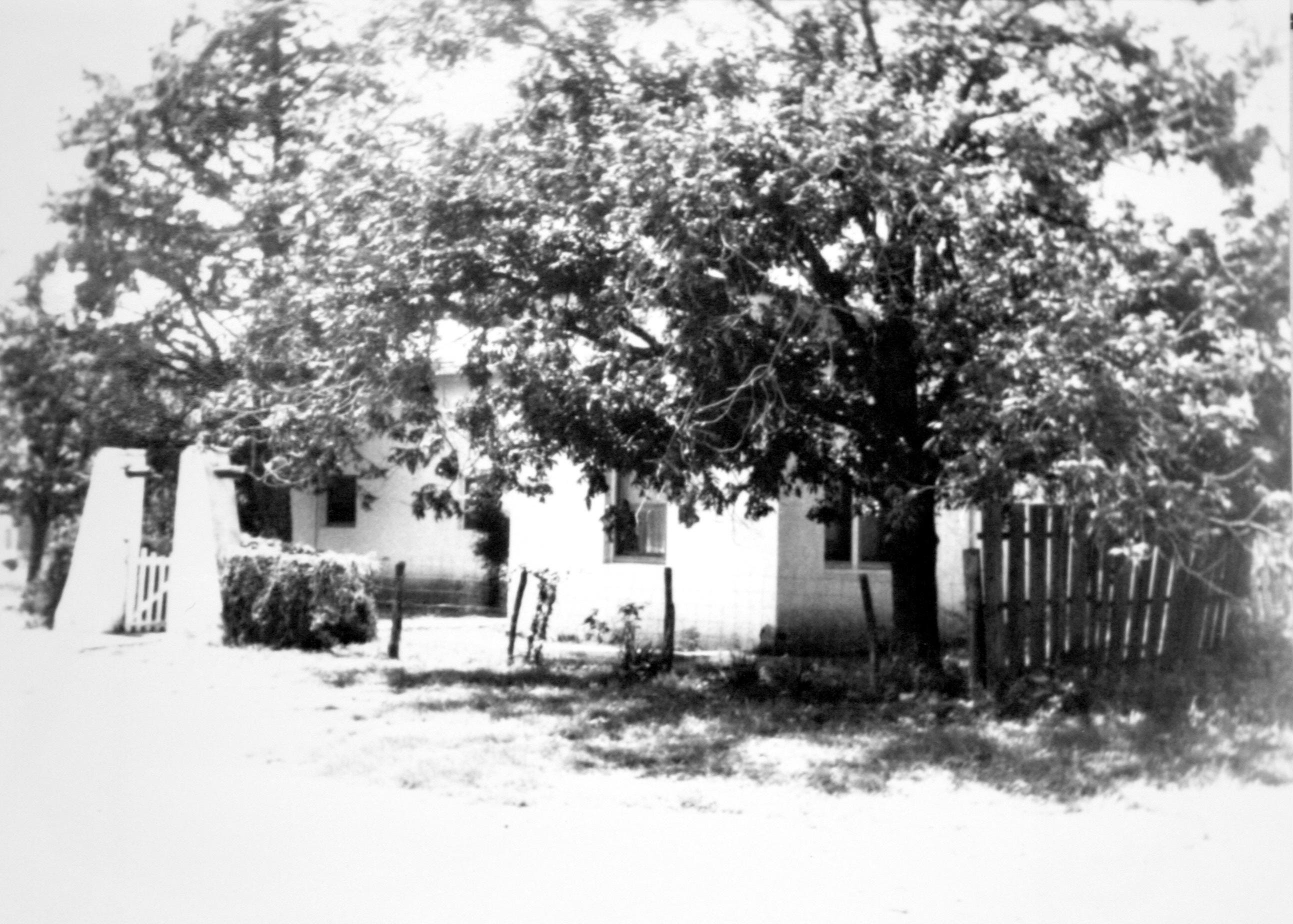
July 1950 - Effie last known visit to Douglas was in 1949 on the occasion of her 80th birthday exhibit. She now lived most of the time with her son Lewis (who is an engineer at the Morenci pit) and his wife Norma (a school teacher). Although she is no longer living in Douglas, the Douglas Daily Dispatch reports Effie has sent four new paintings to hang in the Douglas Chamber of Commerce offices. The newspaper refers to her as the Dean of Arizona Women Artists.
We have not yet seen any paintings by Effie dated 1950. Again, they are ‘out there’ somewhere. Her last known painting - likely a view of the mountains around Morenci dated 1952 is probably one of her final summer paintings from a long and passionate creative life.
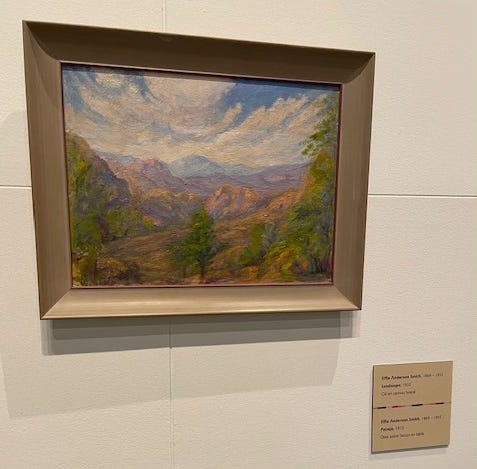
Effie’s life is proof of the idea that you may indeed someday achieve all your dreams. You just may not achieve them all at once, as Oprah Winfrey has observed.
Effie strived to achieve her dreams of a fulfilling married and family life while also retaining the personal independence and autonomy she needed to express herself artistically.
These many summer milestones, Effie’s decisions, the challenges life threw at her, and the various turning points she faced sometimes facilitated her progress - and at other times pulled her back. Her patience and perseverance helped her navigate life, with her faith and her art as refuge.
ART IN A MINING CAMP
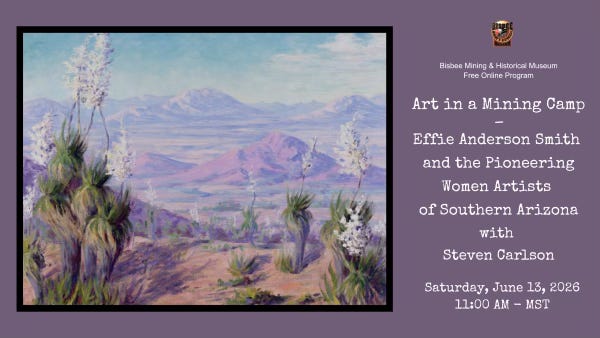
If you missed my recent online talk you may view it on the Bisbee Mining & Historical Museum’s YouTube Channel.
A few week’s back I was introduced to Bisbee Mining & Historical Museum’s global webinar audience by the Museum’s Executive Director - Annie Graeme Larkin, our wonderful host for our current exhibit in Bisbee.
During my talk I highlighted Effie’s inspiring life story and her relationships with the many younger women art students and nascent arts communities developing in the mining camps and smelter towns of Arizona and beyond.
Watch it on the Bisbee Mining & Historical Museum’s YouTube Channel.
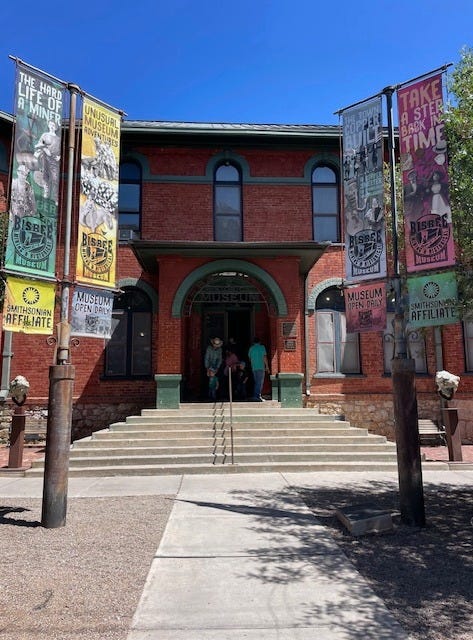
Our current exhibit - IMPRESSIONS OF THE DESERT - is on view at the Bisbee Mining & Historical Museum. They are open EVERY DAY with their amazing mineral collections and local history exhibits - and this year hosting our Effie Museum collection of paintings in the glorious and historic board room of the old Phelps Dodge Mining Headquarters (erected 1897).
Remember - Bisbee is a Mile High City so you’ll likely enjoy cooler temps there than anywhere else in Southern Arizona. Come join us and see Effie’s art in Bisbee!
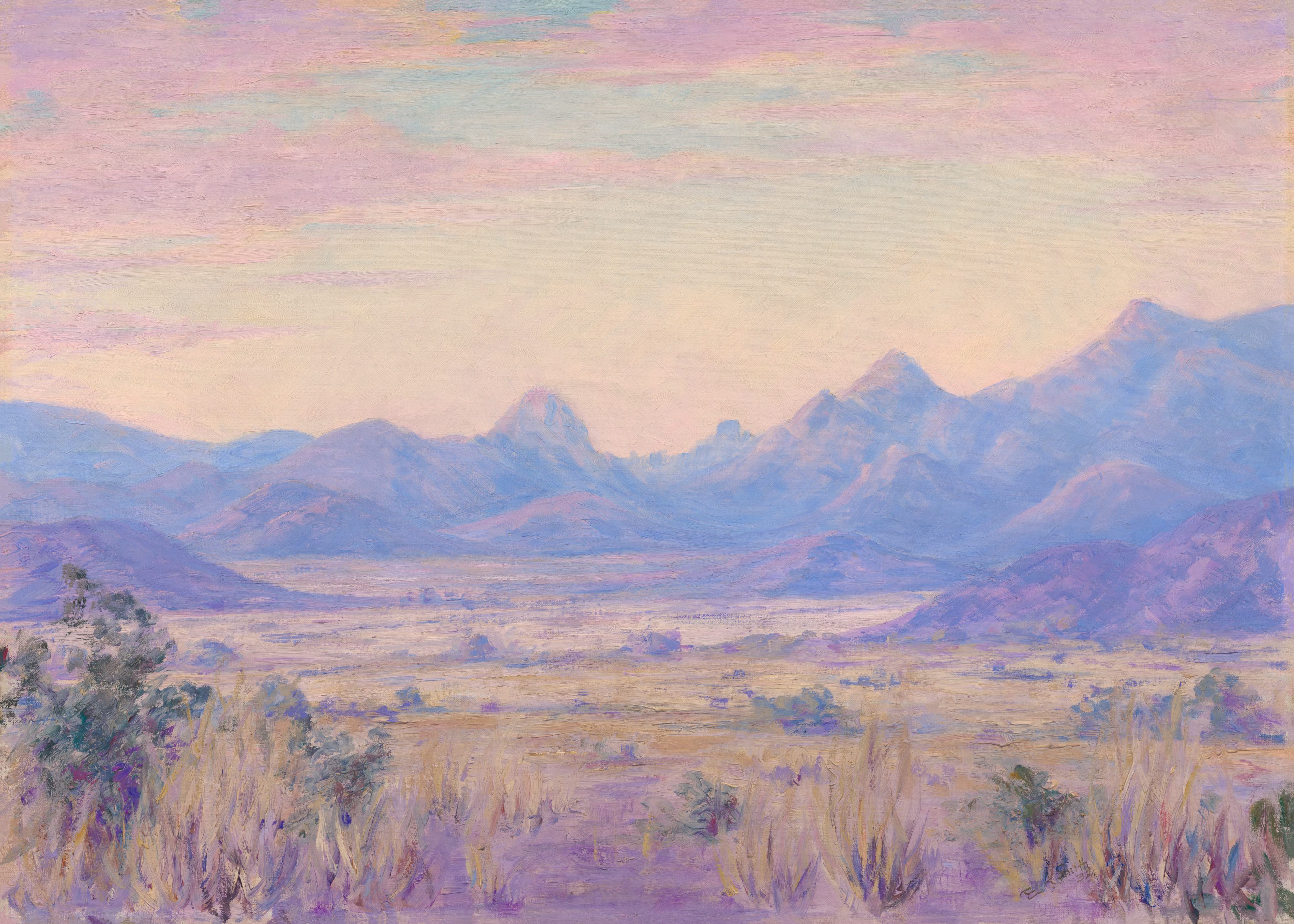
YOU CAN HELP SHARE EFFIE’s ART WITH NEW AUDIENCES.
If you enjoyed this EFFIEgram please consider simply sharing it with a friend!
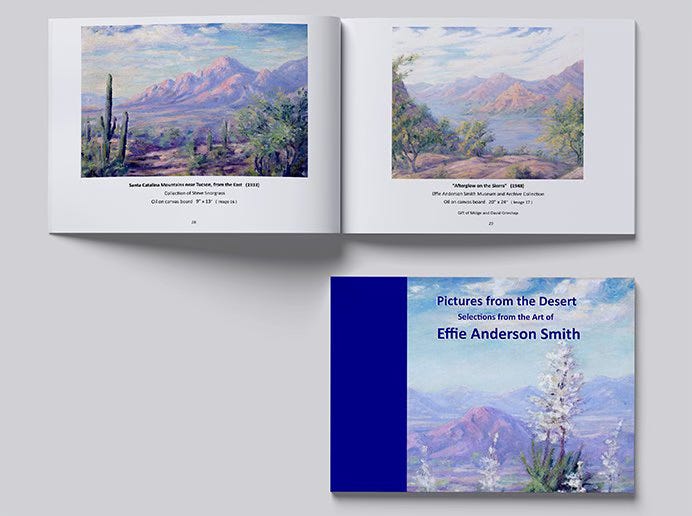
Now Available - PICTURES FROM THE DESERT - Fine Art Booklet
If you’d like to support our exhibits and work to preserve Effie’s artistic legacy and her inspiring life story - you can do so with a donation in any amount to the Effie Anderson Smith Museum and Archive on our SUPPORT page - and become part of our Effie Art Community!
Our Museum is now offering you - as a THANK YOU GIFT - for those of you who support our work with a donation of $ 10 per month (or a one-time donation of $ 100) a copy of PICTURES FROM THE DESERT - our 40 page full color booklet featuring 17 full page images of Effie’s finest paintings and the stories behind them.
Donate Today!